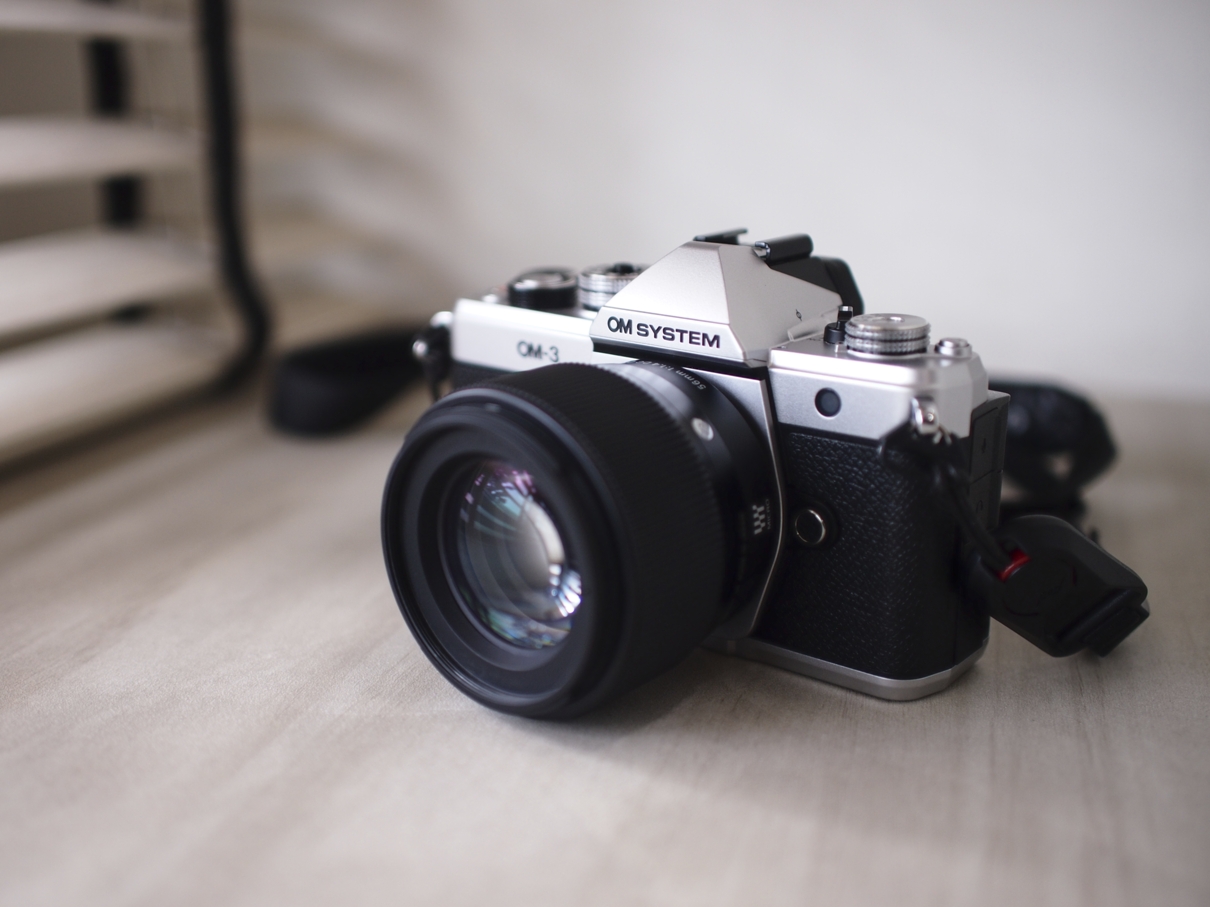

Ok let me just say this – I’m impressed by this little beast. Was just browsing a few days ago and spotted one going online for about 300USD so I pulled the trigger and got this both on impulse and for the fact that I have been eyeing for a specialist portraiture lens for a while.
Well, the thing is, I haven’t been taking portraits for some time now ever since I got busy at work and stopped wedding/portraiture photography years ago, but recent life events have got me itching to have a go again (at portraiture mind you, not weddings!) with the M.Zuiko 45mm 1.2 and PanaLeica 42.5mm 1.2 being high on my shortlist. I have always been fond of PanaLeica primes and the f1.2 of both lenses feels and sounds oh so sexy, but hey, this Sigma sits at a pretty penny at 300USD that I reckon it will not hurt as much to give it a go and so I did.
Having been shooting on the Canon Eos Full-Frame platform years ago, I was curious on how the Sigma will perform with m43. It is the equivalent of shooting a 112mm (in terms of field of view) and at f2.8 (in terms of blur separation; depth of field) on Full Frame 35mm format. Whatever the case is, I was keen to see how the Sigma handles,
- Sharpness (Im not going to be too technical here, but a portrait lens has to have acceptable sharpness if you’re not looking at a soft focus lens)
- Separation (background blur) of subject in a full body portrait
- Separation in a head + shoulder portrait
- Separation in close-up
- Bokeh (quality of background blur) rendering and its blur transitions
- AF Performance
Sharpness
Testing the lens at portraiture shooting distances, I can vouch for the sharpness of the lens. My personal preference is for portrait lenses to be sharp and this exceeded my expectations so far. It’s sharp wide open at 1.4, and maybe too sharp even.
It is so sharp at close-ups and head+shoulder portraiture distances that flaws in the subject’s skin will come up even at 1.4 in good lighting and this can prove an issue if you do not intend to post process the images. Personally, I find that this can be a distracting element to portraitures and having super sharp portraits are not really what I like. To remedy this, you can try dialing down the sharpness in-camera so the straight-out-of-camera JPEGS will turn out a tad bit softer, but I have yet to try this for myself.
Background Separation (Full-Body Portrait)

Background Separation (Head+Shoulders portrait)

Background Separation (Close-Up Portrait)

Bokeh Rendering

Take note that all these photos are, straight-out-of-camera, shot wide open at 1.4 with my Micro Four Thirds OM-3 camera and I think they surpassed my expectations for a portrait lens. You can achieve good separation to get pleasing results in all the portrait scenarios tested. Bokeh quality is also very pleasing, evident in the close-up portrait where the blur transitions of the model’s headscarf appears very smooth and likewise the pigeon picture showing a reasonably pleasing transition in a very challenging rendering task for the lens in the out-of-focus transition of the grass leading up to the pigeon.
How Does It Compare to Full Frame portraiture?
Why the relevance of this question? Because I know at the heart of all ‘sub-calibre’ (I term all shooters on smaller than the full frame 35mm format that) photographers lies the itch to ‘upgrade’ to a Full Frame platform in chasing the holy grail of Bokeh and Dynamic Range ‘perfection’ (Medium and Large Format shooters, shhhhh! Just look away for now).
Well, what I can say is that m43 has its advantages, AND disadvantages when being compared to the combo I had been shooting before (Eos 5Dii/6D, 70-200mm 2.8, 85mm L 1.2).
The m43 combo with the Sigma 56mm 1.4 is very wieldy and easy to maneuver around in a portraiture session compared to say an FF combo with an 85mm 1.2. It makes moving around a piece of cake. Autofocus of the Sigma is also very snappy as its glass elements are smaller and noticeably lighter than its FF equivalents. I loved the EF 85mmL 1.2 USM. Its rather sharp, its bokeh is out-of-this-world, but its glass is rather heavy and focus is a tad bit slower than the Sigma. At least it felt like it.
Where the Sigma loses out is on background separation, as the 85mm 1.2 separates subject much better due to the razor thin DOF, and have I mentioned before? – That the bokeh of that lens is just so darn good. However, I recalled using the lens that I almost never used f1.2 on that lens due to the very thin depth of field. Minimum aperture for FF lenses is at f2.2 or 2.4 for me.
End Note
So what’s my verdict on the Sigma 56mm 1.4 DC DN lens for Micro Four Thirds? It’s an almost a specialist portraiture lens on the m43 format and if you are on the hunt for one and on a budget, I think this is the go-to lens. It’s a no brainer. Buy it and use it.
You’re Welcome.
Leave a Reply